
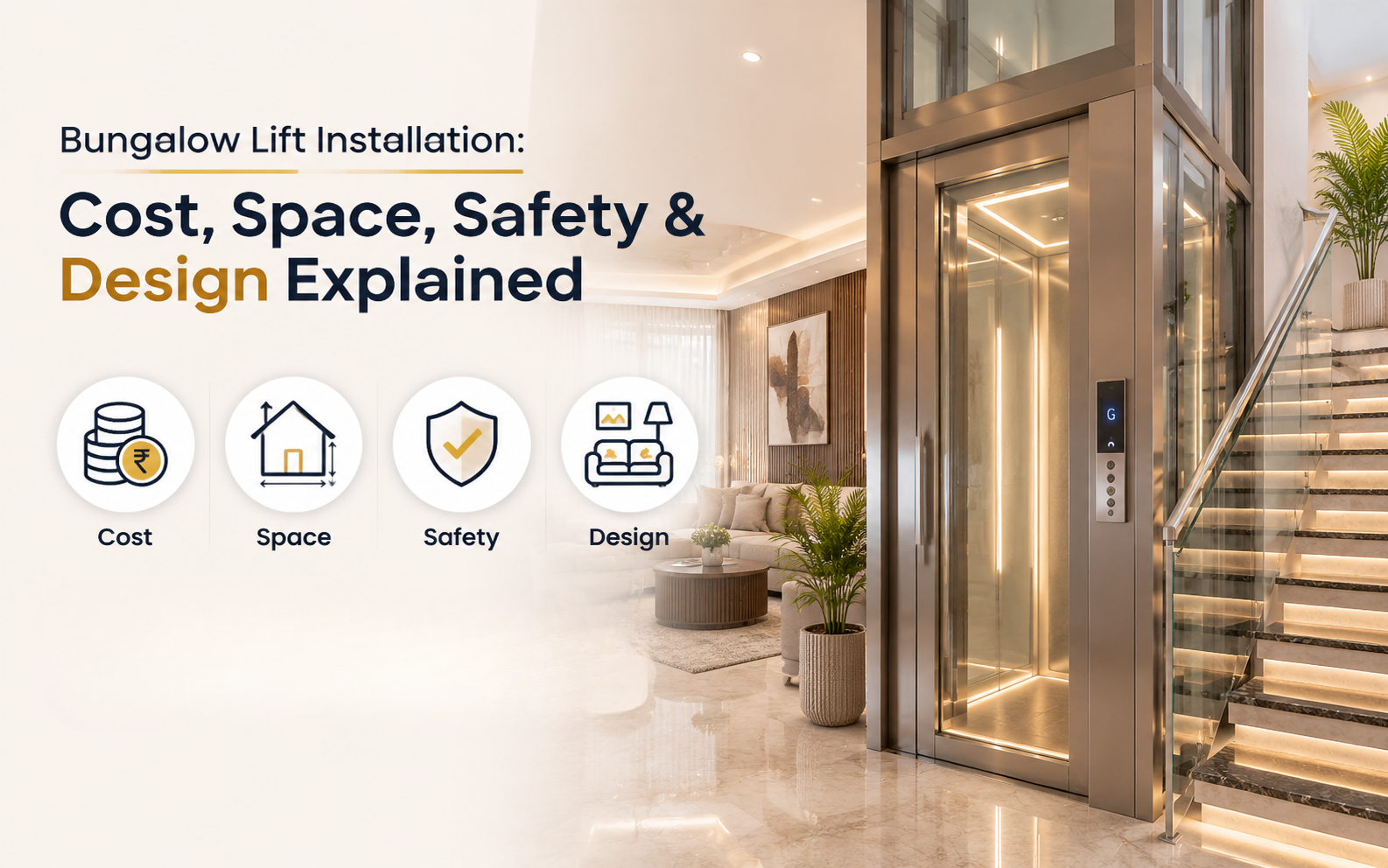
Bungalows in Ahmedabad are getting taller. What used to be a simple ground-plus-one home is now often a ground-plus-two or three, with terraces, home offices, and guest floors stacked on top of each other. Somewhere along the way, climbing that many stairs every day stops feeling practical and starts feeling like a design flaw.
That’s usually the point where homeowners start looking into a bungalow lift. But once you start researching, the questions pile up fast: how much space does it actually take, is it safe for daily family use, and will it look out of place in a home you’ve spent years getting right?
This guide answers all three, in plain terms, so you know exactly what to expect before you call anyone. If you’re already comparing options, we’ll also explain what separates a genuinely reliable installer from just another name on a search results page.
How Much Space Does a Bungalow Lift Actually Need?
This is almost always the first concern, and the answer surprises most people. A bungalow lift doesn’t need the kind of bulky shaft you’d picture from a commercial building.
- Most residential cabins fit into a footprint of around 4 to 5 feet by 4 to 5 feet
- Compact and pneumatic systems can fit into spaces as small as 1.2 m by 1.2 m
- Many homes already have enough unused space near a staircase, store room, or courtyard corner
The right approach depends on whether you’re building fresh or retrofitting. New construction gives an architect the freedom to plan the shaft into the layout from the start. In an existing bungalow, a low-pit or pit-free system usually avoids breaking into the ground floor slab altogether.
Overhead clearance and pit depth
Most systems need somewhere between 2600 mm and 3000 mm of clearance above the top floor, and a pit of up to 250 mm below the ground level, depending on the drive type chosen. Pneumatic systems typically skip the pit requirement entirely, which is worth asking about if your bungalow’s ground floor is already finished.
Safety Standards Every Bungalow Lift Should Meet
Convenience is only half the reason people install a home lift. The other half is peace of mind, especially in homes with children or elderly family members using it daily.
A properly engineered bungalow lift should include:
- Automatic emergency braking in case of power failure or overload
- Interlocked doors that won’t open unless the cabin is correctly positioned
- Battery backup so the lift can reach the nearest floor safely during a power cut
- Overload sensors that prevent operation beyond the rated capacity
These aren’t optional add-ons. Any bungalow lift supplier in Ahmedabad worth considering should include these as standard, not as a premium upgrade you have to ask for separately.
Warranty and after-sales support
Ask specifically about warranty coverage and annual maintenance contracts (AMC) before signing anything. A lift that isn’t serviced regularly becomes a safety liability over time, no matter how well it was built initially.
Design Options That Actually Suit a Bungalow
A bungalow lift doesn’t have to look like it was bolted on as an afterthought. With the right cabin finish, it can complement the home’s existing interior instead of standing out awkwardly.
- Glass cabins work well in bungalows with an open, contemporary layout, since they let light pass through instead of blocking sightlines
- Stainless steel cabins suit a more understated, classic aesthetic and tend to be easier to maintain long term
- Capsule-style enclosures add a striking visual element when placed near an entrance or staircase landing
Most manufacturers also offer customisation around lighting, flooring, and door style, so the lift feels like part of the home’s design rather than a purely functional add-on.
What to Check Before You Choose an Installer
Not all lift installations are equal, and this is where a lot of homeowners run into trouble later. Before signing a contract, confirm the following:
- Maximum height and floor coverage the system supports (many bungalow lifts handle up to G+15, though most homes need far less)
- Passenger capacity and whether it accounts for future needs, like a wheelchair or stretcher
- Drive type, since AC and hydraulic systems differ in speed, smoothness, and long-term running cost
- Whether civil work, wiring, and finishing are handled in-house or outsourced separately
The best bungalow lift manufacturer in Ahmedabad will walk your site in person before quoting anything. If a company is willing to give you a firm price without ever seeing your home, that’s usually a sign to look elsewhere.
Quick Checklist Before Your Site Visit
- Measure the length, width, and floor-to-floor height of your intended lift location
- Note what’s directly above and below the spot (terrace, basement, parking)
- Decide how many floors the lift needs to serve now, and possibly later
- Think about cabin finish and how it should match your home’s interior
- Ask every shortlisted supplier about warranty terms and AMC coverage upfront
Planning a Bungalow Lift for Your Home?
Every bungalow is laid out differently, and the only way to know exactly what fits is a proper site visit. Gulf Elevators has been designing and installing bungalow lifts across Ahmedabad for years, with in-house civil work, engineering, and after-sales support handled under one roof.
Book a free site assessment with Gulf Elevators or explore our full range of home elevator solutions to find the right fit for your bungalow.